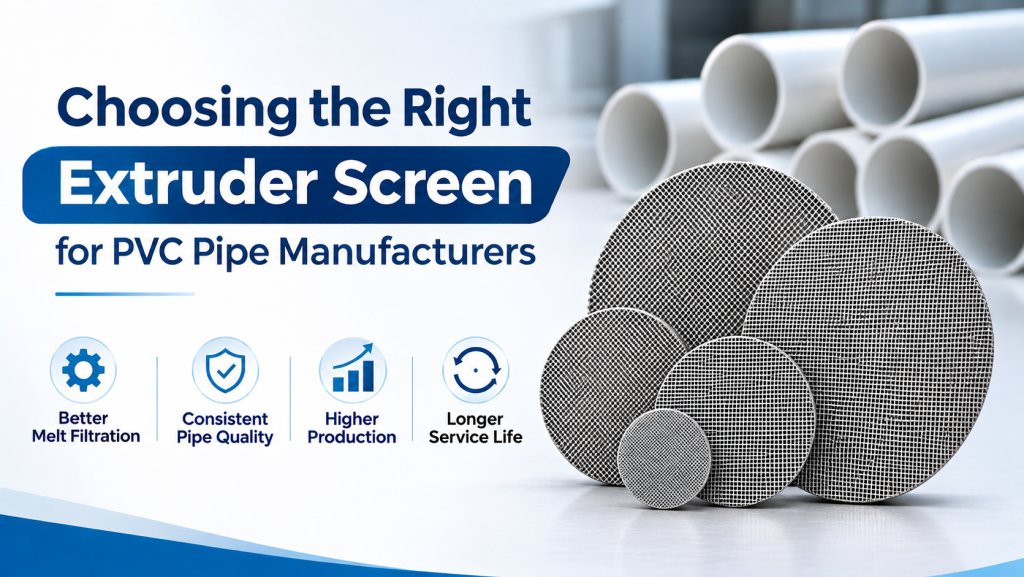
Choosing the Right Extruder Screen for PVC Pipe Manufacturers
Extruder Screen Manufacturer & Supplier for PVC Pipe and Fittings Industry
In the PVC pipe manufacturing industry, maintaining consistent product quality, smooth extrusion, and uninterrupted production is essential. Every component of the extrusion line plays an important role in achieving these goals. One such critical component is the extruder screen.
An extruder screen may appear to be a small part of the extrusion system, but it has a significant impact on melt filtration, contamination control, and overall extrusion performance. Choosing the right extruder screen helps PVC pipe manufacturers improve production efficiency, maintain consistent pipe quality, and reduce unnecessary machine downtime.
This article helps PVC pipe manufacturers and plant engineers understand why PVC compound requires specific screen specifications, how different pipe types and compound formulations affect screen selection, which screen types perform best in PVC pipe production, and what factors must be considered to choose the right extruder screen for their specific line.
 Call Now!
Why PVC Pipe Extrusion Has Unique Filtration Requirements
PVC pipe extrusion is one of the most demanding environments for any extruder screen. PVC compound is thermally sensitive, carries stabilisers, lubricants, fillers, and pigments that add to the filtration load in every production run. Every material must be fully dispersed before the melt reaches the pipe die. Undispersed particles passing through an inadequate extruder filter screen create surface defects, weak spots in the pipe wall, and inconsistent wall thickness that can cause a pipe to fail pressure testing.
PVC Pipes and fittings processes at lower temperatures than most polymers, typically 160 to 200 degrees Celsius, meaning higher melt viscosity and elevated back pressure through the screen. This places greater mechanical demands on the extruder screen pack, requiring screens that maintain structural integrity under sustained high back pressure without deforming or allowing melt bypass. Thus, selecting the right PVC pipe extruder screen is the most crucial and important decision in extrusion line.
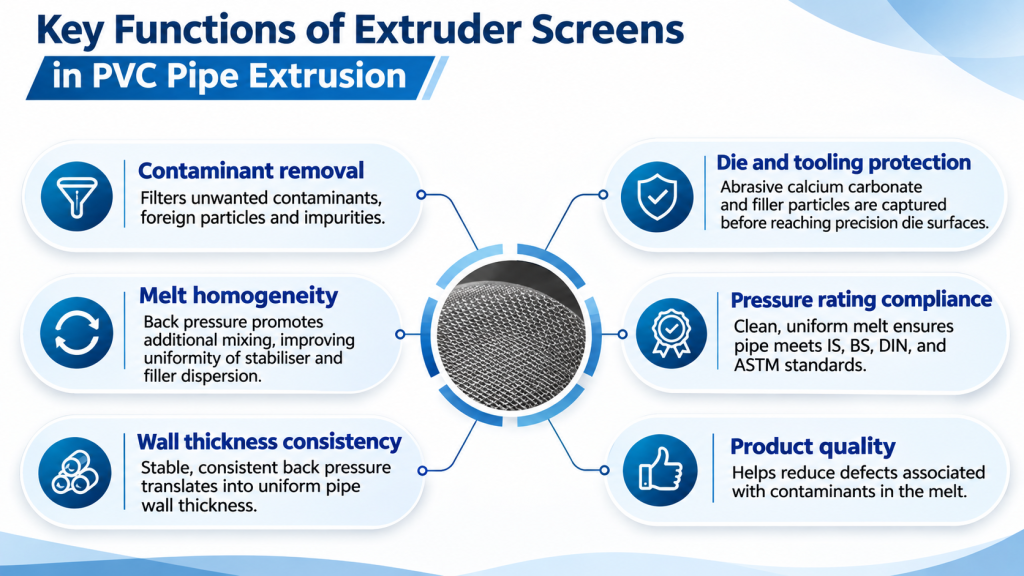
Key Functions of Extruder Screens in PVC Pipe Extrusion
During the extrusion process, raw plastic materials are heated and melted before being pushed through an extrusion die to produce pipes of the required shape and dimensions. Extruder screens are installed in the melt filtration system, generally before the die, to help remove contaminants and unwanted particles from the material flow. The right extruder screen mesh improves melt filtration, maintain consistent production, protect downstream equipment and support the manufacturing of high-quality PVC extrusion system.
| Key Function | Role in PVC Pipe Extrusion |
| Contaminant removal | Filters unwanted contaminants, foreign particles and impurities from molten plastic material |
| Melt homogeneity | Back pressure from the screen promotes additional mixing, improving uniformity of stabiliser and filler dispersion |
| Wall thickness consistency | Stable, consistent back pressure translates directly into uniform pipe wall thickness around the circumference |
| Die and tooling protection | Abrasive calcium carbonate and filler particles are captured before reaching precision die surfaces |
| Pressure rating compliance | Clean, uniform melt ensures pipe meets IS, BS, DIN, and ASTM dimensional and pressure rating standards |
| Product quality | Helps reduce defects associated with contaminants in the melt |
Types of Extruder Screens Used in PVC Pipe Manufacturing
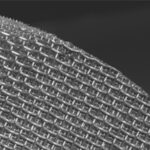
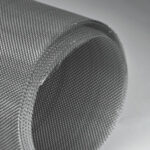
Extruder screens are generally manufactured using stainless steel wire mesh in different mesh counts, sizes, and configurations to suit specific extrusion requirements. Depending on the machine design and application, manufacturers can choose from different screen configurations
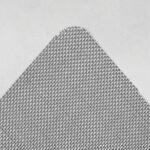
- Single Layer Extruder Screens: Stainless steel 304L wire mesh screens are widely used in plastic processing and extrusion filtration applications. Single layer extruder screens are used on PVC pipe lines with virgin raw material with less contamination level. They are cost-effective for high-frequency changeover lines and pair well with all types of screen changers. Mainly for screen changers with fast replacement and minimal interruption.
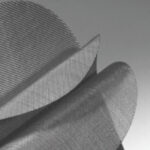
- Multilayer Circular Screen Pack: Spot welded extruder screens in a multilayer configuration are the primary filtration tool for PVC pipe extrusion. Coarse outer layers provide structural support and capture larger particles, while fine inner layers remove undispersed filler and stabiliser particles that cause surface defects. The spot-welded extruder pack construction prevents layer separation under high back pressures, making this multi-layer mesh packs the industry standard across PVC pressure pipe, conduit and drainage pipe production.
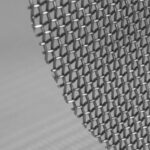
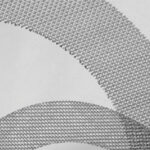
- Multimesh Circular Screen: For PVC applications requiring the finest filtration such as transparent PVC tubing or medical-grade profiles, multimesh circular screens manufactured from Plain Dutch or Twilled Dutch weave stainless steel 304L wire mesh deliver micron-level filtration and are widely used as the inner layer in premium high filtration extruder screens
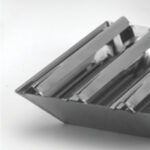
- Custom Design Extruder Screens and Filter Discs: Some PVC pipe extrusion machines require non-standard screen geometries or disc-format filtration elements. Custom filtration solutions including designer screens and filter discs are manufactured to exact machine specifications for consistent filtration performance.
The ideal screen depends on polymer type, extrusion process, required filtration level, melt viscosity, production output, contaminant load and screen changer configuration.
Our Other Product
Multilayer Cylindrical Screen Pack - Candle FiltersHow to Select the Right Extruder Screen for Your PVC Pipe Extrusion Line
Not every extruder screen is suitable for every PVC pipe extrusion application. The right selection depends on the extrusion machine, material characteristics, production requirements, and filtration objectives.
Here are the major factors PVC pipe manufacturers should consider.
- Raw Material Type and Contamination Level: High-CaCO3 drainage pipe compounds require abrasion-resistant screens. Low-filler uPVC pressure pipe requires finer filtration for wall uniformity and pressure rating compliance. Therefore, knowing the raw material and how much contamination it contains is the first step towards better filtration.
- Mesh Count and Filtration Requirements: Mesh count refers to the number of openings per linear inch of a wire mesh. It is one of the most important considerations when selecting an extruder screen. A higher mesh count generally provides finer filtration, while a lower mesh count offers larger openings and allows greater particle passage. However, selecting an excessively fine mesh may increase flow resistance and pressure build-up.
- Screen Pack Layers and Configuration: Single-screw and twin-screw extruders have different melt characteristics and breaker plate geometries. PVC pipe manufacturers should select mesh specifications based on raw material quality, filtration requirement and desired product output.
- Screen changer Compatibility: Manual screen changers work better with durable multilayer screen packs that last longer and reduce the need for frequent screen changes. Hydraulic and continuous screen changers require screens with accurate dimensions to ensure proper fitting and smooth operation.
- Operating Pressure and Temperature: Extrusion conditions play an important role in screen selection. The screen pack must be suitable for the machine’s operating temperature, melt pressure, and production requirements. An unsuitable screen combination may result in excessive pressure build-up, reduced material flow, or frequent screen replacement.
Always work with an experienced industrial extruder screens exporter who understands PVC extrusion process and has technical expertise.
Benefits of Using the Right Extruder Screen in PVC Pipe Extrusion
| Benefits | Impact on PVC Pipe Production |
| Consistent Product Quality | Stable back pressure from correct screen specification ensures uniform pipe wall around full circumference |
| Reliable Pressure Performance & Compliance | Uniform melt delivery supports compliance with IS 4985, BS EN 1452, DIN 8061, and other pipe standards |
| Improved Surface Finish | Effective filtration helps produce smoother pipe surfaces, reducing customer complaints. |
| Protection of Critical Machine Components | By capturing unwanted abrasive particles, Extruder Screen helps to protect important machine components such as die mandrels and sizing bushes. |
| Reduced Production Downtime | Helps reduce frequent screen replacements and allows better planning of screen changeovers. |
| Lower Scrap and Rejection Rates | Cleaner melt reduces gel spots, surface defects, and dimensional variation that cause pipe rejections |
 Email Us !
Choosing the right manufacturing partner is just as important as selecting the correct screen specification. PVC pipe manufacturers should look for an leading extruder screen manufacturer that understands industrial filtration requirements and can provide consistent product quality.
Important factors to evaluate include:
- Manufacturing experience in wire mesh filtration
- Consistent Quality & Stainless Steel Wire Mesh Standard Compliance
- Availability of different mesh counts and screen configurations
- Custom manufacturing capabilities
- Mesh Quality Certification
Our Other Product
Circular Extruder ScreenFrequently Asked Questions
What type of extruder screen is best for PVC pipe extrusion?
Multilayer circular screen packs with spot welded extruder screens are the standard for PVC pipe extrusion. Their bonded multi-layer construction handles the combined filtration demands of fillers, stabilisers, and lubricants in PVC compound under elevated back pressure.
Why does PVC pipe extrusion need a different screen specification from other polymers?
PVC compound contains calcium carbonate filler, stabilisers, lubricants, and pigments that must all be fully dispersed before the melt reaches the pipe die. PVC also processes at higher melt viscosity than most polymers, creating elevated sustained back pressure. These factors mean PVC pipe extrusion screens must handle a heavier combined filtration and pressure load than most other extrusion applications.
Which material is best for extruder screens in PVC pipe manufacturing?
SS 304 extruder screens are the standard for PVC pipe extrusion. SS 304L offers corrosion resistance against hydrogen chloride that PVC can release during processing, temperature stability across the full PVC processing range, and the tensile strength needed to withstand sustained high back pressure.
How do extruder screens affect pipe wall thickness consistency?
A correctly specified extruder screen pack creates stable back pressure at the breaker plate, regulating the uniformity of melt flow entering the pipe die. Consistent melt flow directly determines wall thickness uniformity. Mismatched screens cause back pressure fluctuation and wall thickness variation, a common cause of pipe failing dimensional or pressure rating tests.
What extruder screen is recommended for high-filler PVC drainage pipe compounds?
Spot welded extruder screens in a multilayer configuration are recommended for high-calcium-carbonate drainage pipe compounds. Their bonded construction resists abrasive filler wear, with coarse outer layers capturing bulk filler particles and fine inner layers removing smaller contamination before the melt reaches the pipe die.
How many layers does an extruder screen pack need for PVC pipe production?
The correct number of layers depends on PVC compound type and contamination level. Contact Ambica Group with your machine specification and filtration requirement for the correct configuration.
Where can PVC pipe manufacturers in India source certified extruder screens?
Ambica Group, based in Ahmedabad, Gujarat, is a trusted extruder screens manufacturer & supplier in Gujarat, India with over 50 years of experience supplying the PVC pipe industry. Ambica provides certified SS 304L extruder screens India with AAMCS mesh quality certification, serving PVC pipe manufacturers across India.
Whose extruder screens are trusted by PVC pipe manufacturers globally?
Ambica Group is a global extruder screens supplier trusted by PVC pipe manufacturers in 65 countries. As a certified extruder screen manufacturer and exporter, Ambica Group supplies high-performance extruder screens, a certified PVC pipe extrusion screens to pipe manufacturers worldwide.
Latest Post
-
Choosing the Right Extruder Screen for PVC Pipe Manufacturers
-
Extruder Screens for Wire & Cable Manufacturing: Applications, Benefits & Selection Guide
-
Types of Extruder Screens and their Application in Plastic Industry
-
Woven Wire Mesh Guide: Plain Weave vs Dutch Weave vs Twilled Dutch Weave
-
Extruder Screen Mesh Size Explained: Micron Rating & Selection Guide
Catalogue