
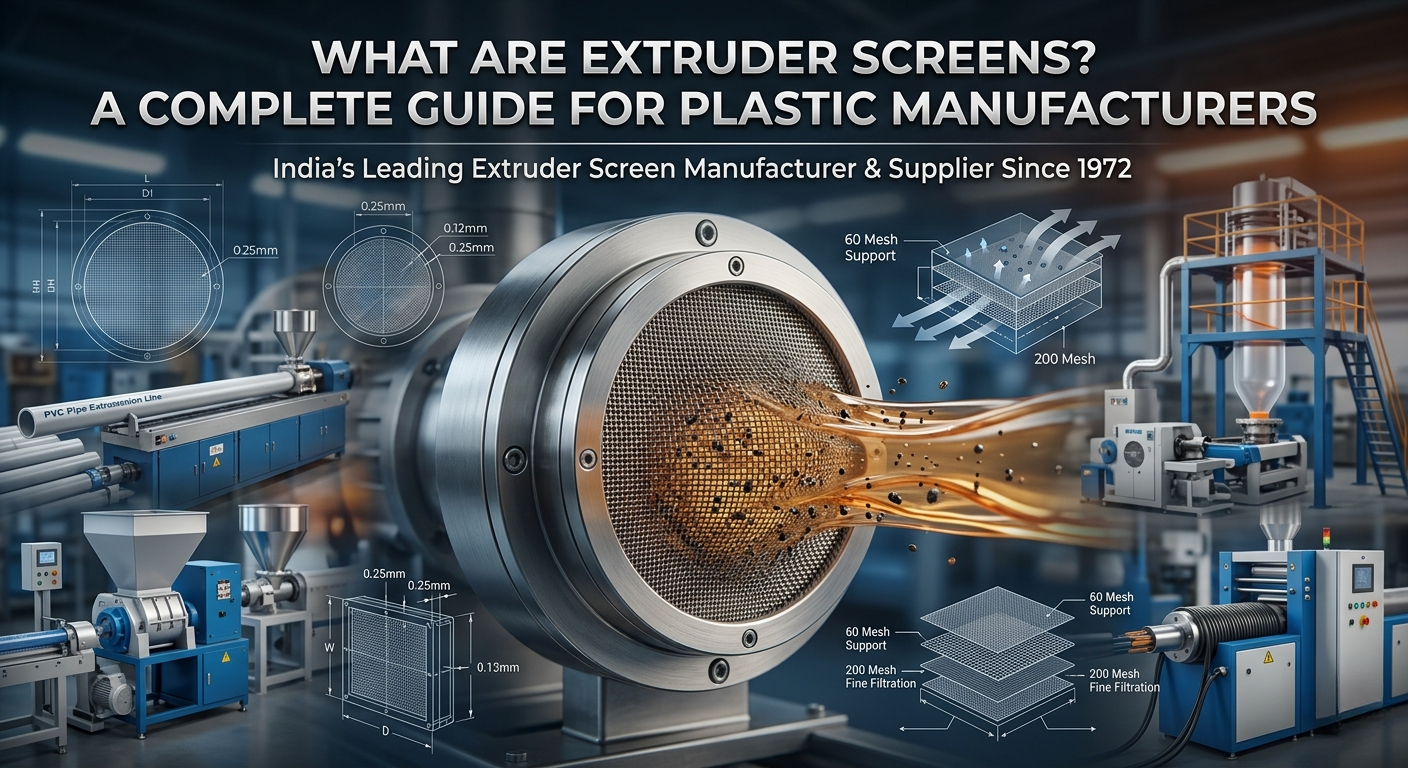
What Are Extruder Screens? A Complete Guide for Plastic Manufacturers
India’s Leading Extruder Screen Manufacturer & Supplier Since 1972
This guide is for plastic manufacturers, plant operators, and procurement managers looking to understand extruder screens their function, types, and material choices. Whether you’re buying for the first time or upgrading for plastic extrusion, recycling, or PVC pipe lines, this article gives you the insights needed to make the right decision for your extrusion process.
In any plastic extrusion operation whether you’re making PVC pipes, BOPP films, woven sacks, air bubble film, masterbatch, monofilament yarn, or recycled plastic granules, one essential component that keeps your extrusion technology running at peak efficiency and your finished product defect-free are the extruder screens.
Extruder screens, also known as melt filter screens or screen packs, are the first line of quality control in plastic extrusion process. However, they are often under-specified and poorly sourced. This guide covers everything you need to know about extruder screens.
What Are Extruder Screens?
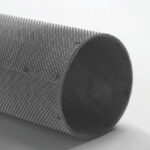
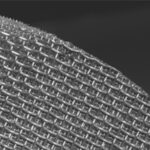
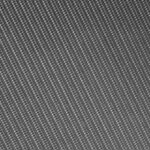
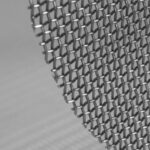
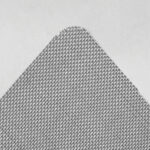
An extruder screen also commonly known as an extruder screen pack, melt filter screen, wire mesh extruder screen, or plastic extrusion screen is a woven wire mesh disc or multi-layer pack installed inside a plastic extruder, between the screw barrel and die head. Its primary job is to filter out contaminants, unmelted polymer particles, carbon deposits, and other foreign matter from the molten plastic before it exits the die.
Extruder screens come as single-layer discs for clean, virgin material processing or multilayer packs for recycled or contaminated melts. They are placed against a breaker plate inside the extruder barrel, where they operate under extreme conditions, typically temperatures of 200°C to 300°C and back pressures ranging from 500 to 5,000 psi, depending on the polymer and throughput.
Depending on the application or industry, this product may also be referred to as a melt filter, polymer filter screen, plastic extrusion screen, breaker plate screen or candle filter screen.
 Drop Us an Email!
How Extruder Screens Work in the Plastic Extrusion Process?
Extruder screens play a key role in ensuring the efficiency of your plastic extrusion process. Raw polymer pellets whether virgin or recycled, are fed into the extruder hopper. Inside the barrel, a rotating screw melts and moves the material forward under pressure. Before the molten plastic reaches the die, it must pass through a breaker plate with extruder screens.
The screens trap contaminants like gels, unmelted granules, carbon specks, and metal particles. This allows clean melt to pass through to the die for shaping, which is essential for melt filtration in extrusion. As contamination builds, back pressure in the barrel rises, and when it hits the target level, the screens need to be changed. This is done either via a manual screen changer or using a hydraulic or automatic device that replaces clogged screens with minimal production interruption.
Why Your Machine Needs Quality Extruder Screens?
Choosing the best extruder screens for plastic extrusion isn’t just about quality – it’s a smart business decision that pays off. Here’s how high-quality extruder screens benefit your process:
- Superior Filtration: Effectively removes gels, granules, carbon specks, metal debris, and other contaminants, ensuring a defect-free final product.
- Consistent melt homogeneity: They improve the mixing of the polymer melt, ensuring uniform product quality.
- Die and equipment protection: They protect expensive dies, gear pumps and costly machinery from damage.
- Back pressure control: Well-maintained screens keep back pressure in check, protecting the extruder screw and barrel.
- Regulatory and quality compliance: For industries like food packaging and pharmaceuticals, clean melt filtration is often a regulatory requirement.
- Reduced scrap and waste: Cleaner melts lead to fewer defects, less waste, and better use of raw materials.
Low-quality extruder screens can rupture under pressure, releasing contaminants and causing costly rejects or equipment damage. Investing in high-performance extruder screens from a leading extruder screen manufacturer is always the better economic choice.
Types of Extruder Screens
| Type | Structure | Best For | Pros | Limitations |
| Single Layer | One mesh layer | Virgin plastic | Cost Effective & Reusable | Limited Durability |
| Multilayer Spot Welded Screens | 2–5 welded layers | Recycling, high contamination | High strength & long Lasting | Single Time Use |
| Aluminium Ring Screens | Framed mesh | Light-duty applications | Easy handling | Frame Deformation Risk & Higher Cost |
Single Layer Extruder Screens
Single layer extruder screens are made of one layer of precision woven wire mesh cut to the required shape and size. Cost-effective and ideal for extrusion of clean, virgin polymers like PE, PP, or PET film.
Common mesh counts range from 20 mesh (coarse, around 850 microns) for general support, 60 to 80 mesh (medium fine, 250 to 180 microns) for standard filtration, and 100 to 150 mesh (fine) for cleaner melts. Higher mesh numbers provide finer filtration but clog faster under contamination.
Example: Single Layer Extruder Screens used in PET sheet extrusion lines with low contamination & virgin raw material.
Multilayer Screen Packs: Spot Welded Screens vs. Aluminium Ring Screens
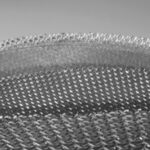
Multilayer screen packs combine 2 to 5 layers of woven mesh with varying mesh counts. The outer layers are coarser to catch larger particles, while the inner layer is finer for precision contamination removal. A common configuration is 20/40/80/40/20 or 20/60/100/60/20 multimesh extruder screen, arranged symmetrically so the pack cannot be installed backwards.
Multilayer packs are essential for plastic recycling, masterbatch compounding, colour concentrates, PVC pipe extrusion, and plastic film extrusion, especially for BOPP and multilayer films.
Example: Multilayer Extruder Screens are used in plastic recycling lines handling reprocessed material with high contamination level.
Two main edge-finishing methods:
- Spot Welded Screens: Layers are welded for a secure, frame-free bond, ideal for high-pressure environments.
- Aluminium Ring Screens: An aluminium frame holds the mesh together but can deform under pressure, making spot welded screens more reliable for high-output or high-pressure lines.
| Buyer Tip: Always confirm with your extruder screen supplier whether multilayer packs are spot welded or aluminium framed. For recycling lines, PVC pipe extrusion, BOPP film, and high-output extruders – spot welded screen packs are more superior and cost-effective choice. |
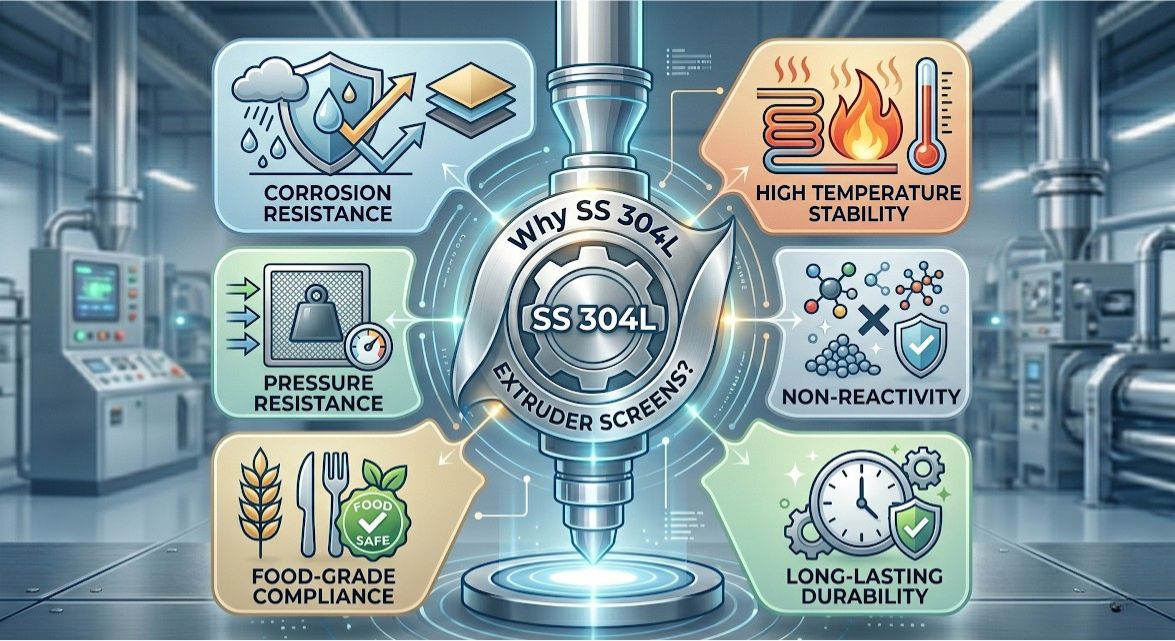
Materials Used in Extruder Screens: Why SS 304L Is the Industry Standard
The material of your extruder screen affects its durability, filtration, contamination risk, and overall cost. Stainless Steel 304L (SS 304L) is the most widely used material of extruder screen in the plastic processing industry for several reasons:
| Material | Key Benefit | Use Case | Limitation |
| SS 304L | Polymer Extrusion Process | Polymer Extrusion Process | Not for aggressive chemicals |
| SS 316L | Higher corrosion resistance | Food & Pharmaceutical Industry | Higher cost |
| Carbon Steel | Extreme resistance | Specialty polymers | Single time Use |
- Corrosion resistance: SS 304L Grade Screens resists more rust, oxidation, and chemical attacks preventing metallic contamination of the plastic melt.
- High temperature stability: It maintains structural integrity at high temperatures (up to 870°C), offering a much longer service life than mild steel screens.
- Pressure resistance: SS 304L Grade Screens have high tensile strength helps it withstand the back pressures common in polymer melt filtration, especially in high-output lines.
- Non-reactivity: It does not chemically interact with most polymers like PP, PE, PET, HIPS, PC, and PVC.
- Food-grade compliance: SS 304L is suitable for extrusion processes requiring food contact material certification.
- Long-Lasting Durability: SS 304L Extruder Screens are trusted choice across India and worldwide, engineered to withstand demanding extrusion conditions while delivering superior strength, durability and an extended operating life.
Ambica Group specializes in manufacturing and exporting high-quality SS 304 L (Low Carbon – high 8% Nickel) wire mesh & woven wire cloth product ranging from 10 to 500 mesh (upto 2 micron) filtration precision.
Why Choosing the Right Extruder Screen Matters: The Perfect Extruder Screen Selection Guide
Choosing the right extruder screen is crucial for efficient plastic extrusion. Here are key factors to consider:
- Raw Material Selection: Virgin polymer needs lower filtration (single layer or coarse multilayer), while recycled materials need finer, high-capacity multilayer screens.
- Filtration Rate: General polymer extrusion requires 20-60 mesh count (375-250 microns). Film extrusion uses 80-150 mesh (180-100 microns) and Precision applications like fibers or pharmaceuticals need 200 mesh or above (74 microns or finer).
- Operating pressure and temperature: High-pressure, high-temperature lines need robust spot-welded multilayer screens made from SS 304L while lower-duty applications can use simpler configurations.
- Screen dimensions: Ensure the screen matches the extruder breaker plate diameter and thickness. Even small variations can cause issues like melt bypass or pressure leaks.
- Screen changer compatibility: Screens must be consistent and durable enough to handle rapid changeovers without deforming.
- Application-specific design: PVC pipe extrusion requires heat-stable mesh, film extrusion needs precise mesh openings, and recycling needs high contamination capacity with strong layer bonding.
If unsure about specifications, reach out to an experienced extruder screen supplier. Ambica Group’s technical team helps customers worldwide select the best screen configuration for their needs.
Benefits of Using Extruder Screens in Plastic Processing
For any plastic manufacturer the benefits of using high-quality extruder screens extend across product quality, machine health, and operating economics. Here is a consolidated view of why extruder screens are non-negotiable in modern extrusion technology:
- Superior product quality: Extruder filter screens remove contaminants at the melt stage, preventing defects in plastic extrusion applications like packaging, medical, and food-grade products.
- Extended die life: Screens capture abrasive particles before they reach the die, protecting expensive extrusion tooling and increasing its lifespan.
- Reduced machine wear: Clean melt reduces stress on extruder screws, barrels, and gear pumps, lowering maintenance costs and downtime.
- Process consistency: Stable back pressure and uniform melt improve product dimensions, wall thickness, and overall quality.
- Higher output efficiency: Properly maintained screen packs ensure smooth production without pressure fluctuations or output loss.
- Cost-effective quality control: Extruder screens reduce scrap, waste, and rejection costs, making them a low-cost, high-impact investment.
- Versatility across applications: Suitable for PP, PE, PET, PVC, PS, HIPS, PC, nylon, and other polymers across multiple industries.
- Compliance support: Certified high-filtration extruder screens help meet food-grade, pharmaceutical, and export quality standards.
In short: Extruder screens are the simplest and most cost-effective quality intervention available to any plastic processor.
Know About
Stainless Steel Wire Mesh TerminologySigns Your Extruder Screen Needs Replacement
Recognizing when an extruder screen needs replacement is crucial for preventing production issues. Here are the key signs to watch for:
- Rising back pressure: The most obvious sign. When pressure increases above the normal baseline at the breaker plate, the screen is loading with contaminants.
- Falling output rate: A clogged screen restricts melt flow, lowering production rates.
- Rising melt temperature: Screen Clogging can causes frictional heat, which can degrade polymers, cause discoloration, or change viscosity.
- Product defects: Gel streaks, black specks, holes in film, or variations in wall thickness often signal an overloaded screen.
- Sudden pressure spike then drop: A dangerous warning sign, indicating a screen rupture that releases all trapped contaminants. Immediate inspection and screen replacement are required.
To prevent extrusion clogging issues, track pressure changes after each screen replacement. This helps create a reliable replacement schedule, minimizing downtime. Choosing high-quality extruder screens supplier like Ambica Group extends the time between changes, improving overall efficiency.
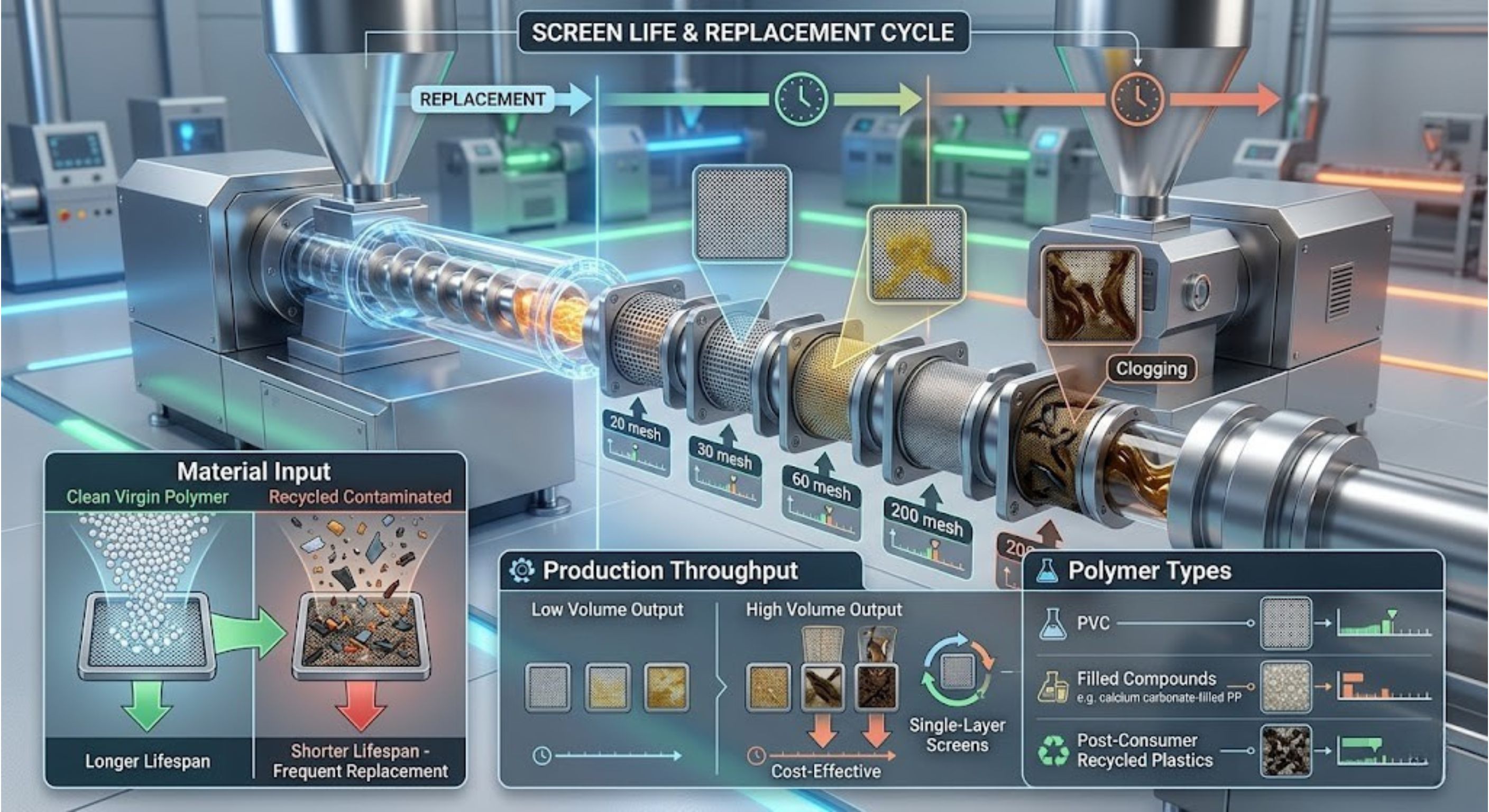
Extruder Screen Lifespan and Replacement Frequency
Extruder Screen product life is highly variable and depends on several interacting factors:
- Melt cleanliness: Virgin polymer with few impurities allows screens to last days or weeks, while heavily contaminated recycled material may require frequent changes every few hours or multiple times per shift
- Filtration fineness: Finer mesh screens clog faster than coarser ones, even with the same contamination.
- Output throughput: Higher production rates lead to faster contamination buildup on screens.
- Polymer type: Materials like PVC, filled compounds, and recycled post-consumer material are more demanding on screen loading.
For a practical cost perspective, manufacturers should consider:
- Small single-layer screens for high-volume, cost-effective operations.
- Larger multilayer spot-welded packs, which have a higher upfront cost but provide better value per hour of filtration.
Extruder screen replacement costs should always be evaluated in relation to the total production cost per tonne, not just the price per screen.
Ambica Group offers bulk extruder screens to reduce per-unit costs for high-frequency replacements, and premium multilayer screen packs for applications requiring longer screen life and consistent filtration.
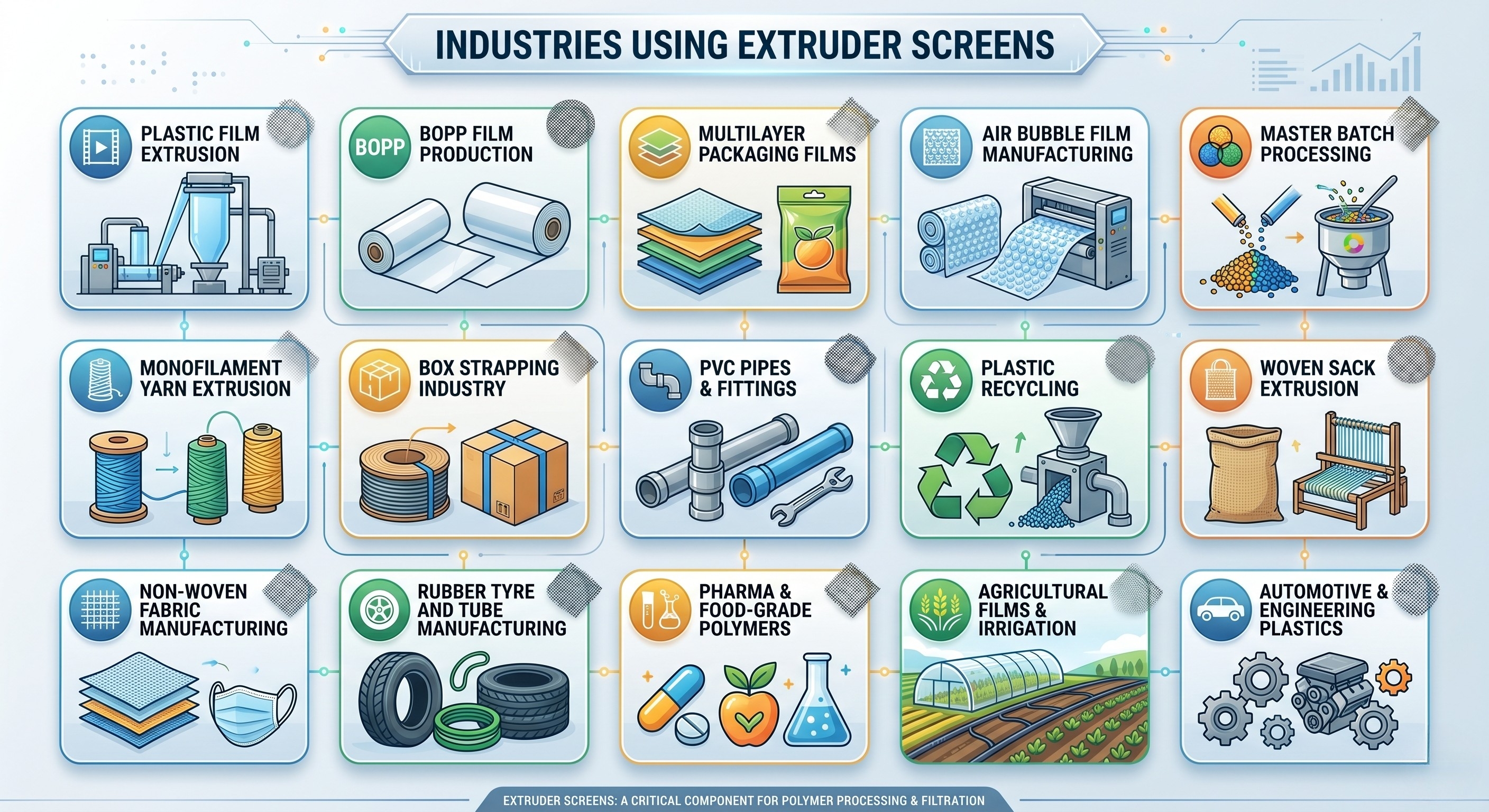
Industries Using Extruder Screens
Wire mesh filter screen packs serve every major segment of the plastic and rubber processing industry. Key industries and applications include:
- Film Extrusion
- BOPP Film Production
- Multilayer Packaging Films
- Air Bubble Film Manufacturing
- Master Batch Processing
- Monofilament Yarn Extrusion
- Box Strapping Industry
- PVC Pipes & Fittings
- Plastic Recycling
- Woven Sack Extrusion
- Non-Woven Fabric Manufacturing
- Rubber Tyre and Tube Manufacturing
- Pharma & Food-Grade Polymers
- Agricultural Films & Irrigation
- Automotive & Engineering Plastics
As one of India’s best extruder screens for plastic extrusion suppliers, Ambica Group serves manufacturers across all of the above industries – with a customer base exceeding 6,000 clients in India and exports to 50+ countries across Asia, Middle East, Europe, and Africa.
 Get in Touch
Common Mistakes Buyers Make When Sourcing Extruder Screens
- Focusing solely on price: Cheap extruder screens often use inferior materials, leading to early failure, contamination and extra costs from rejects.
- Lack of mesh certification: Filtration performance depends on mesh quality. Always ask for mesh certification to ensure reliability. Ambica Group’s AAMCS provides traceable quality data.
- Wrong mesh specification: The ideal mesh count should be determined by your raw material specifications, machine temperature, operating pressure, and the quality standards of your final output.
- Dimensional mismatch: Screens must match your breaker plate’s diameter and thickness. Even slight variations can cause melt bypass and filtration failure.
- Using aluminium ring frames: Avoid aluminium framed screens in high-pressure and high-temperature applications, as they are not only unsuitable but also a more expensive option. Spot-welded packs offer a more durable and cost-effective solution.
- Improper storage: Steel screens rust in humid environments. Stainless steel should be stored in sealed packaging to avoid rust contamination.
- Reusing screens: Screens are single-use. Cleaning won’t restore the mesh after high-pressure service, risking filtration failure.
- Sourcing from unknown suppliers: Always test a free sample before bulk ordering. Ambica Group offers free samples for this purpose.
Why Choose Extruder Screens from India's Leading Extruder Screen Manufacturer?
With over 50 years of experience, Ambica Group is a trusted name in manufacturing extruder screens. Based in Ahmedabad, Gujarat, we offer a wide range of high-quality wire mesh extruder screens and screen packs, serving industries globally. Our strengths include:
- Over five decades of expertise in manufacturing woven wire cloth and extruder screens
- High Quality SS 304L extruder screens ranging from 10 to 500 mesh (upto 2 micron)
- Spot welded multilayer screen packs engineered for high-pressure & high filtration needs
- Proprietary quality assurance with our Ambica Automated Mesh Certification System
- Custom manufacturing for any shape, size, or mesh specification i.e. Designer Screens
- Exporting to over 65 countries worldwide
- Extruder screen free samples available to ensure you get the right fit
Ambica Group is the reliable, experienced screen packs supplier for all your extruder screen needs.
Frequently Asked Questions (FAQs) About Extruder Screens
An extruder screen is a woven wire mesh disc, either single or multilayer, placed between the barrel and die head of a plastic extruder. It filters out contaminants and unmelted particles, ensuring product purity and protecting equipment.
Single layer screens are for clean, virgin polymer with low contamination. Multilayer packs, with 2-5 layers, are ideal for higher filtration needs like plastic recycling, masterbatch, and PVC pipe extrusion.
Spot welded packs are stronger and more durable under high temperatures and pressure, unlike aluminium ring frames which are not cost effective and can deform, leading to layer separation and melt bypass.
Select mesh based on the material: 20-40 mesh for virgin plastic, 40-80 mesh for general extrusion, 80-150 mesh for plastic film, and 200+ mesh for precision applications. For recycled materials, multilayer configurations like 20/40/80/40/20 are ideal.
The cost depends on the diameter, mesh, layers, and material grade. Single layer screens are more affordable, while multilayer SS 304L spot welded screens offer better durability and value over time.
Key signs include rising back pressure, reduced output, higher melt temperatures, product defects (gels, black specks), and sudden pressure changes, indicating screen clogging.
SS 304L offers corrosion resistance, high temperature stability, tensile strength, and doesn’t react with most polymers. It ensures longer life and consistent filtration in plastic extrusion.
Ambica Group, based in Ahmedabad, is a leading manufacturer with over 50 years of experience. They provide high-quality extruder screens and custom solutions, trusted by clients in over 50 countries.
Latest Post
-
Extruder Screens for Wire & Cable Manufacturing: Applications, Benefits & Selection Guide
-
Types of Extruder Screens and their Application in Plastic Industry
-
Woven Wire Mesh Guide: Plain Weave vs Dutch Weave vs Twilled Dutch Weave
-
Extruder Screen Mesh Size Explained: Micron Rating & Selection Guide
-
Extruder Screens for Plastic Recycling Industry & Sustainable Solutions
Catalogue